Learn · Explainer

What is vapor smoothing?

Vapor smoothing is a chemical finishing process for 3D printed polymer parts. A controlled solvent vapor softens the outer skin of the part, the surface reflows and seals, and the part comes out smooth inside and out. PostPro systems by AMT run it as one automated cycle: Conditioning · processing · curing · drying.

No cost to evaluate · Parts returned · Typical turnaround 2–3 weeks

Drawn cross-section of a part surface in three steps. As printed, a powder-bed part has partly fused grains and open pores, and an FDM part has layer ridges. Then the solvent vapor softens the top layer. Finally the surface has reflowed into a smooth, sealed skin while the bulk of the part keeps its shape.

  1. Conditioning
  2. Processing
  3. Curing
  4. Drying
A drawing, not a micrograph: the surface before, during and after the vapor.

01The process

How vapor smoothing works

Definition

Vapor smoothing exposes a thermoplastic part to a controlled solvent vapor, so its outer surface softens, flows and resolidifies as a smooth, sealed skin, while the bulk of the part keeps its shape.

A powder-bed 3D printed part, from HP Multi Jet Fusion or selective laser sintering for example, comes out of the printer with a grainy, porous surface made of partly fused powder. Vapor smoothing does not sand that surface away. It melts the very top of it for a moment so it levels itself, closes the pores and sets again. On an FDM part the same reflow levels the layer ridges. On a PostPro system that happens in four automated stages:

  1. Conditioning

    Parts are conditioned in the chamber to reach the right processing conditions.

  2. Processing

    Vaporized consumable is injected into the chamber and smooths part surfaces under controlled conditions.

  3. Curing

    The consumable is removed from the surface and the surface resolidifies.

  4. Drying

    Parts are dried so no consumable remains in the chamber, ready for use.

A full cycle takes up to 2 hours. Because the finishing agent reaches the part as a vapor, it acts on every exposed surface at once, including internal channels that no tool can reach.

02The result

What vapor smoothing does to a part

Four things change, and AMT has published measurements for each. These are the best published results. Results depend on the material and finishing agent used.

TPU bellows as printed, with a rough gray surfaceAs printed
The same TPU bellows after PostPro vapor smoothing, with a smooth, sealed surfaceVapor smoothed
The same 3D printed TPU bellows before and after PostPro vapor smoothing.
  • Surface roughness

    13.42 → 1.18 µm

    As printed to vapor smoothed

  • Sealing

    Reduced surface porosity

    Pores closed at the surface

  • Elongation at break

    up to +38%

    Against as-printed parts

  • Burst pressure

    up to +7%

    A sealed surface holds more pressure

  • Dimensional change

    ≤ 0.4%

    After vapor smoothing

Why sealing matters

A sealed surface takes up less water, dirt and sweat, and is easier to clean. That is why vapor smoothing turns up on parts that are handled, worn or washed: prostheses, food-processing grippers and automotive seals.

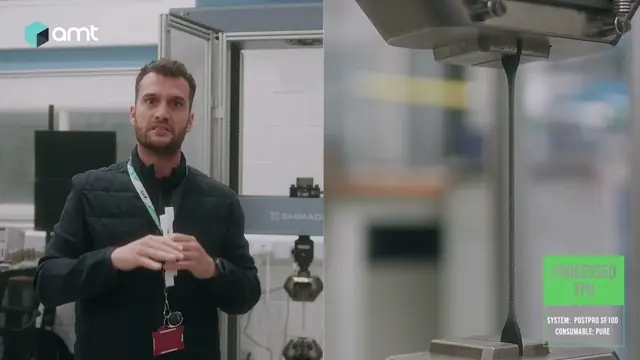
The film shows raw and vapor-smoothed TPU parts pulled to failure in a tensile test at Element Materials Technology, Sheffield.

TPU and elastomer results · PA12 results

Watch on YouTube: Does Vapor Smoothing Make 3D-Printed Parts Stronger? Tensile Test at @ElementTesting (opens in a new tab)

03Compatibility

Which printing processes and materials

PostPro vapor smoothing is built for powder-bed and industrial extrusion parts: MJF, SLS, SAF, HSS and FDM. On those printers it finishes nylons, elastomers and polypropylene, plus a long list of other thermoplastics.

The finishing agent decides the material list. FA5802 (Pure) runs in every PostPro system; FA326 (High performance) adds 100+ thermoplastics on the SF50 and SF100; FA9202 is the dedicated agent for polypropylene. By printing process: MJF · SLS · SAF and HSS · industrial FDM.

04Equipment

Manual vs automated, closed-loop smoothing

Hobbyists smooth ABS prints with acetone vapor in a jar or a heated box. It works on some extrusion plastics, but the operator controls nothing precisely: time, temperature and vapor concentration drift, results vary from part to part, and the solvent vapor escapes into the room.

An automated system runs each cycle from a stored recipe, so time, temperature and vapor concentration are the same every time. The vapor stays inside a sealed chamber and the consumable is recovered instead of escaping into the room. That is what makes vapor smoothing repeatable enough for production parts.

Compare the four PostPro systems

05Alternatives

Vapor smoothing vs other finishing methods

Abrasive methods such as media finishing, tumbling and sanding remove or flatten material and leave the surface open. Dyeing changes color, not texture. Coatings add a layer that seals as long as it stays intact. Vapor smoothing reflows the part’s own surface, so it smooths and seals in one step, and it is often combined with dyeing.

Vapor smoothing vs sanding, tumbling, dyeing and coating, side by side

06Terms

Vapor smoothing vs vapor polishing

Same principle, different starting part. Vapor polishing is the machine-shop name for reflowing the surface of machined plastic parts, usually to bring back clarity on polycarbonate or acrylic. Vapor smoothing is the name used for 3D printed parts, where the process also seals a porous surface. AMT does both: machined plastics run on the PostPro SF100 with FA5802 (Pure).

Vapor polishing for CNC-machined plastics · Not to be confused with vapor honing

07Origins

Who made vapor smoothing industrial

Smoothing plastics with solvents is older than 3D printing. Turning it into an automated, controlled process for industrial 3D printed parts is AMT’s work. Born from University of Sheffield research: AMT was founded in Sheffield in 2017.

  • The first automated vapor smoothing system for powder-bed 3D printed parts: the PostPro3D.
  • The largest patent portfolio in vapor smoothing: 26 granted patents and utility models, among them EP3565712 · GB2582225 · GB2597240B.
  • The world's largest installed base of automated vapor smoothing systems: 900+ PostPro systems installed in 40 countries.

The patents · The team behind them

08Next

Getting started with vapor smoothing

There are three ways in.

  • Test your own parts. Send parts to the free benchmark and get them back vapor smoothed with a report: No cost to evaluate · Parts returned · Typical turnaround 2–3 weeks.
  • Outsource. The PostPro network has 125+ production partners in the PostPro network that sell vapor smoothing as a service. Find a partner.
  • Bring it in-house. Compare the systems, see their starting prices and work out your cost per part: systems · prices · ROI calculator. Compare vapor smoothing systems from several makers, with dated sources.

Questions

Vapor smoothing, explained.

Short answers. Anything else, ask an engineer.

What is vapor smoothing?

Vapor smoothing finishes 3D printed polymer parts with a controlled solvent vapor. PostPro systems seal and smooth powder-bed and FDM 3D printed parts inside and out in one automated cycle with four stages: Conditioning · Processing · Curing · Drying.

Is vapor smoothing the same as vapor polishing?

They work on the same principle: a controlled vapor reflows the surface of a thermoplastic part. Vapor polishing is the usual name for machined plastic parts, vapor smoothing for 3D printed parts, where it also seals the surface.

Which 3D printing technologies does it work with?

Powder-bed and FDM 3D printed parts, from MJF, SLS, SAF, HSS and FDM.

Which 3D printing technologies and materials can be vapor smoothed?

Powder-bed (MJF, SLS, SAF, HSS) and FDM parts. Materials include polyamides (PA12, PA11), TPU and other elastomers, Polypropylene (PP) and FDM materials: Ultem and Onyx on every system, plus ABS and ASA on the SF50 and SF100. The compatible material list for each system names the grades (on the documents page), and the consumables page shows which finishing agent suits which material.

Does vapor smoothing change part dimensions?

In AMT’s published tests, the dimensional change after vapor smoothing was ≤ 0.4%. Results depend on the material and finishing agent used.

How long does it take?

A full automated cycle takes up to 2 hours on every PostPro system.

Can vapor-smoothed parts be used in contact with food?

It depends on the material and the finishing agent: each combination needs its own testing. AMT’s published test results for FA5802 (Pure) are on the consumables page.

Who invented vapor smoothing for 3D printing?

Solvent smoothing of plastics is older than AMT; automated vapor smoothing for industrial 3D printing started at AMT. The first automated vapor smoothing system for powder-bed 3D printed parts: AMT’s PostPro3D. The largest patent portfolio in vapor smoothing, with 26 granted patents and utility models.

Next step

See the price. Run the numbers. Hold the part.

Starting prices are public and the cost-per-part math is yours to check, with no email needed for either. The free benchmark puts your own parts, vapor smoothed, in your hands.

  1. 01Quote

    Build your quote

    Pick a system and its options, and send AMT an itemized quotation request. Each system shows its starting price.

    Build your quote

  2. 02ROI

    Calculate your ROI

    Compare your cost per part with manual finishing, using your own labor rate and volumes. Every assumption is editable.

    Calculate ROI

  3. 03Benchmark

    Test your parts, free

    Ship us your parts with a prepaid label. We vapor smooth them and send them back with before-and-after photos and a benchmark report.

    Test your parts, free

    No cost to evaluate · Parts returned · Typical turnaround 2–3 weeks

Prices: starting prices, excluding tax and shipping; everything else is priced in your quotation.

Not sure which system? Help me choose